.svg)

.webp)
%20(1).webp)
%20(1).webp)


.svg)


✏️ By António Dias, Pre-Sales & Business Developer at IDW
For decades, cybersecurity was based on the "Castle and Moat" paradigm: high walls around the network perimeter and complete trust in anyone inside the walls. However, in 2026, that castle no longer exists. Massive digitalization, hybrid cloud, and the proliferation of AI have destroyed the physical perimeter.
Today, the perimeter is volatile, dispersed, and resides at a single point: the Identity. In this new reality, the Zero Trust model is not a technological option — it's an operational survival strategy.
In the Zero Trust model, the premise is simple: never trust, always verify. User validation can no longer be a one-time event at login; it must be a continuous and contextual process.
According to recent data from April 2026, 82% of security breaches in Portugal continue to involve the human factor, whether through stolen credentials or excessive privileges (Source: Cybersecurity Observatory). Addressing identity means being absolutely certain of who is requesting access and whether they are authorized to perform that specific action, at that exact second.
Many organizations historically made the mistake of granting excessive privileges "for convenience". Implementing Least Privilege means ensuring that each user, device, or application has only the access strictly necessary for its function — and nothing more.
This approach blocks Lateral Movement, a favorite tactic of cybercriminals to navigate the network after an initial intrusion. If an account is compromised but does not have elevated privileges, the attacker's blast radius is drastically reduced. For this access decision to be intelligent, it must be based on rich context:
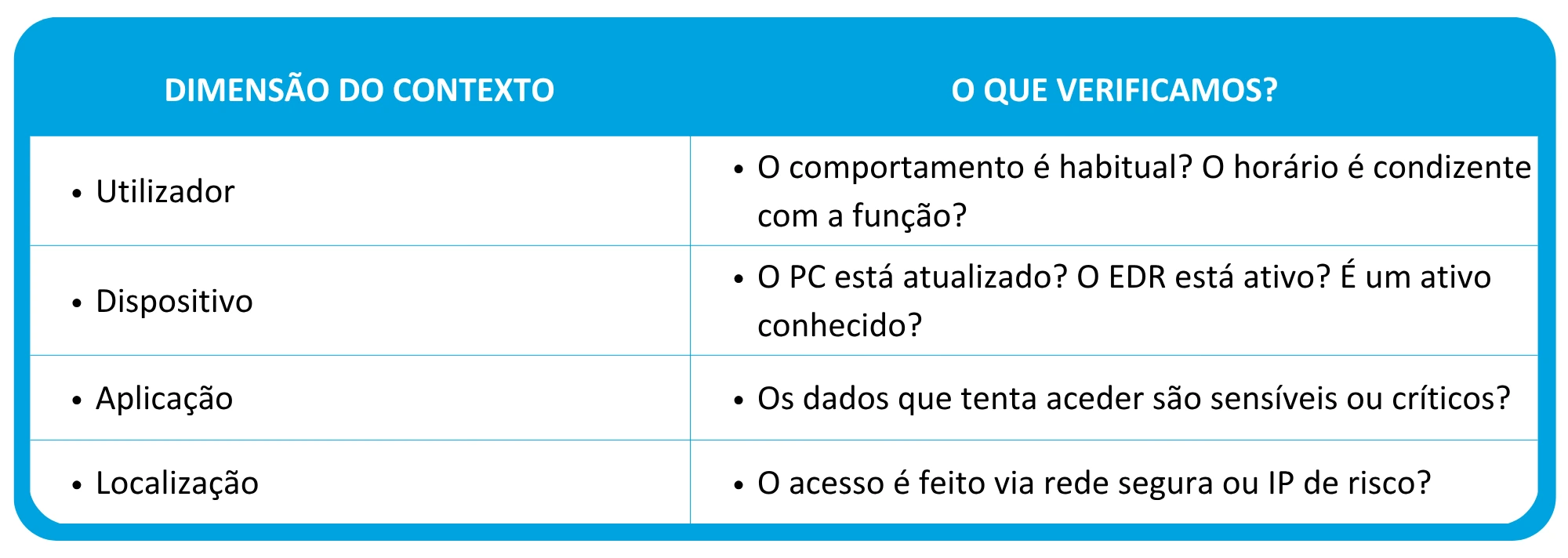
Para transformar a teoria em resiliência, utilizamos dois conceitos fundamentais que definem a maturidade de uma infraestrutura:
O Imperativo NIS2Com a plena aplicação da Diretiva NIS2 em Portugal, a gestão de acessos privilegiados (PAM - Privileged Access Management) deixou de ser uma "boa prática" para ser um requisito legal. A monitorização e gravação de sessões funcionam como a "caixa negra" de uma aeronave: em caso de incidente, permitem reduzir o tempo de investigação (Forensics) de dias para minutos.
Em 2026, a integração de IA e UEBA (User and Entity Behavior Analytics) permite que o sistema detete anomalias em tempo real. Se um administrador começar a exportar subitamente volumes anormais de dados, a sessão é terminada automaticamente por desvio de comportamento.
O Zero Trust começa no controlo de privilégios porque a confiança implícita é o maior risco da era moderna. Ao colocarmos a identidade no centro da estratégia, transformamos a cibersegurança de uma barreira rígida numa malha inteligente, adaptável e, acima de tudo, resiliente. Na IDW, acreditamos que o privilégio não é um direito estático, mas uma variável dinâmica que deve ser gerida com rigor para garantir a continuidade do negócio.